0 Contact

Launch an Agile Release Train (ART)

An ART launch is one of the highest-stakes moments in a SAFe implementation. The sequencing decisions, the leadership alignment, the role readiness required before PI Planning — these are where launches succeed or fail. Getting it wrong isn't just a setback. Recovery is harder than getting it right the first time.

Em Campbell-Pretty and Adrienne Wilson are SAFe Fellows, SPCTs, and the authors of The ART of Avoiding a Train Wreck — a book written specifically about what goes wrong in ART launches and how to prevent it. They bring that pattern recognition to every engagement.

Led by SAFe Fellows who are also SPCTs.

What an ART launch typically involves

Every enterprise takes its own path. But a typical engagement draws from the following, sequenced to your context:

Leadership and portfolio readiness

  • Leading SAFe training
  • Value Stream & ART Identification Workshop
  • ART Design & Launch Planning Workshop

Product and backlog readiness

The 7-Day Quick-Start

The sequence matters as much as the content. Pretty Agile will work with your leadership team to determine the right scope and order for your context — including the leadership alignment work that typically determines whether the ART sustains after launch.

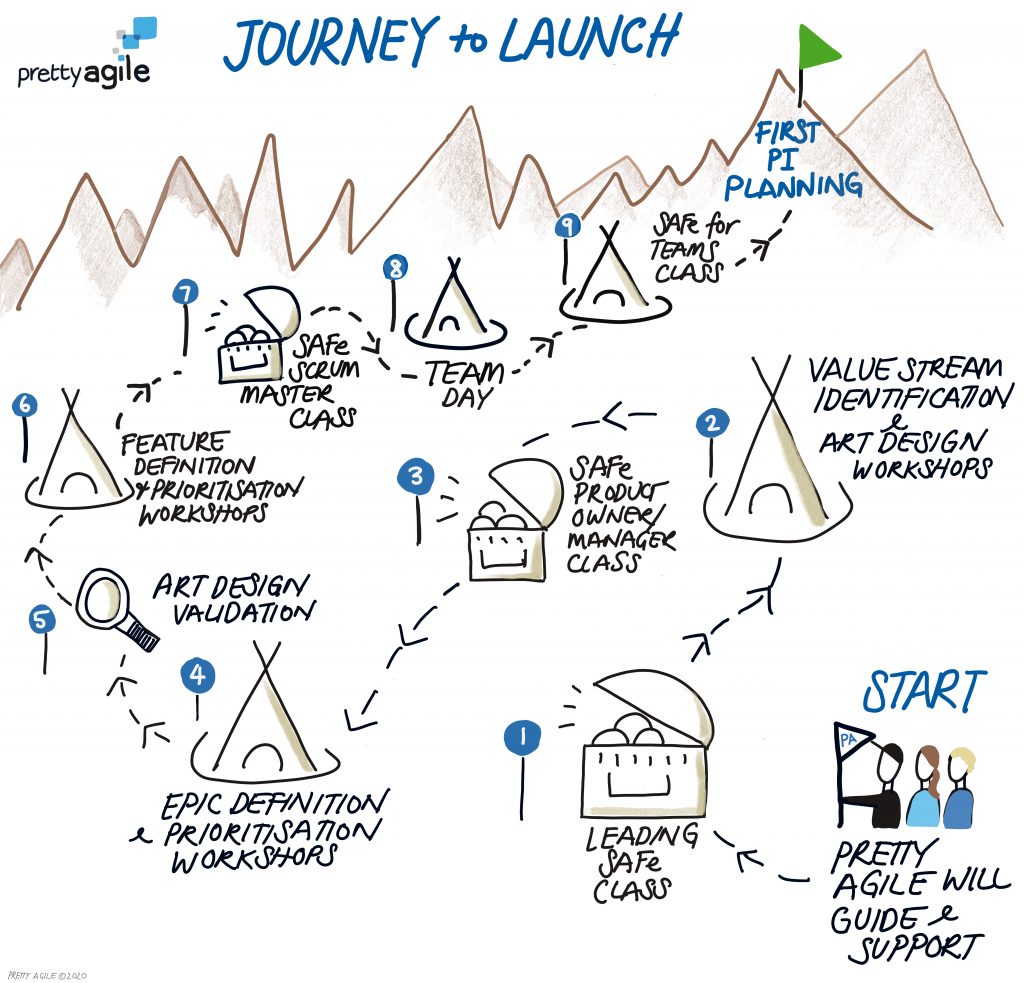
Pretty Agile ART Launch Roadmap

Why it matters who runs the launch

Knowing SAFe and leading a live ART launch are different disciplines. Most launches go well on the day. The ones that struggle do so in the weeks and months after, when the organisational conditions that were papered over during launch become visible.

Pretty Agile has been running ART launches in Australia since 2014. The patterns that predict a difficult launch — and the interventions that address them — are documented in The ART of Avoiding a Train Wreck, which Em and Adrienne wrote from that experience.

  • SAFe Fellows who are also SPCTs
  • Authors of Tribal Unity and The ART of Avoiding a Train Wreck
  • Australia's most experienced Scaled Agile Partner
  • Trained 14,500+ people in SAFe since 2014
  • Scaled Agile Platinum SPCT Partner
  • 100% Australian owned and operated

Ready to launch your ART?

Talk to us about your context, timeline, and readiness. We'll help you plan the right sequence.

Frequently asked questions

A SAFe Practice Consultant (SPC) is qualified to implement SAFe and launch Agile Release Trains. An SPCT — SAFe Program Consultant Trainer — is the highest credential Scaled Agile issues. There are SPCTs in Australia, but the credential alone doesn't tell you how many ART launches someone has actually run.

Above the SPCT tier sits the SAFe Fellow program — capped at 50 practitioners globally, awarded by Scaled Agile for sustained contribution to enterprise agility at scale. Pretty Agile has two: Em Campbell-Pretty, one of the original four Fellows when the program was established, and Adrienne Wilson. Both are also SPCTs.

For an ART launch, the credential matters less than the pattern recognition that comes from having run many of them — knowing where the sequencing decisions are, what leadership alignment problems look like before they surface, and what the first PI Planning reveals about whether the launch will hold. That experience is what The ART of Avoiding a Train Wreck is built on.

Most ART launches go well on the day. PI Planning runs, teams form, the energy is good. The problems surface in the weeks and months after — and they're rarely about the framework.

The most common causes:

Leadership alignment doesn't hold. Leaders participate in the launch, then return to existing behaviours — funding by project, managing by activity, escalating decisions that should stay with teams. The ART runs the motions but the organisational conditions haven't changed.

The sequencing was wrong. Value stream identification was skipped or rushed. Teams were formed before the work was understood. Product Managers weren't ready. The first PI Planning reveals the gaps, but by then the organisation has already declared the launch a success.

Role readiness was assumed, not built. RTEs, Scrum Masters, and Product Owners were appointed without the preparation to perform the role inside a live ART. The first iteration exposes this and it's hard to recover quickly.

The launch was treated as the finish line. An ART launch is the starting condition, not the outcome. Organisations that invest heavily in the launch and lightly in the first 90 days tend to plateau early.

Pretty Agile's approach addresses each of these directly — including the leadership alignment work that typically determines whether the ART sustains after launch.

Not always before — but leadership readiness needs to be resolved before PI Planning, not after.

The most common mistake is sequencing leader training too late. Leaders who haven't done Leading SAFe before the first PI Planning don't yet have the context to make the decisions PI Planning surfaces: funding, team structure, priorities, trade-offs. They either disengage or override — both create problems the ART carries for months.

The practical sequencing: Leading SAFe for the leadership cohort, then Value Stream and ART Identification, then the design and readiness work, then the 7-Day Quick-Start into PI Planning. Compressing or reordering this is where most launch problems begin.

Pretty Agile will map the right sequence for your context at the start of the engagement.

A well-sequenced ART launch from initial workshops to first PI Planning typically runs eight to fourteen weeks, depending on organisation size, leadership readiness, and how much preparation work is needed before teams can form.

The 7-Day Quick-Start — SAFe Scrum Master training, Team Day, SAFe for Teams, and PI Planning — is the final sprint, not the whole engagement. The preparation work that precedes it is where the timeline varies most.

Trying to compress below eight weeks is possible but increases risk. The work that gets cut is usually the leadership alignment and product readiness work — which are the same conditions that determine whether the ART holds after launch.